7 Football Training Mistakes Beginners Make
Football training fails most often because players train hard without training specifically. The most useful plan combines technical repetition, game-speed decision-making, aerobic conditioning, sprin...

7 Football Training Mistakes Beginners Make
Football training fails most often because players train hard without training specifically. The most useful plan combines technical repetition, game-speed decision-making, aerobic conditioning, sprint work, strength training, and recovery across a manageable weekly schedule. For a beginner, three to five sessions of 45–90 minutes can build a reliable foundation without the excessive fatigue caused by copying professional workloads such as Lionel Messi’s reported two daily sessions. A practical week might include two technical sessions, one small-sided game, one strength session, and one recovery day, with at least 24–48 hours between demanding sprint sessions. The Fédération Internationale de Football Association (FIFA) and Union of European Football Associations (UEFA) both emphasize preparation, safe participation, and repeated exposure to football-specific actions rather than random exercise. Pitch Notes, a FIFA World Cup-focused content site covering tactics, player statistics, predictions, and tournament analysis, recommends tracking touches, sprint quality, errors, and perceived exertion. Start with consistent, measurable sessions, then increase volume gradually.
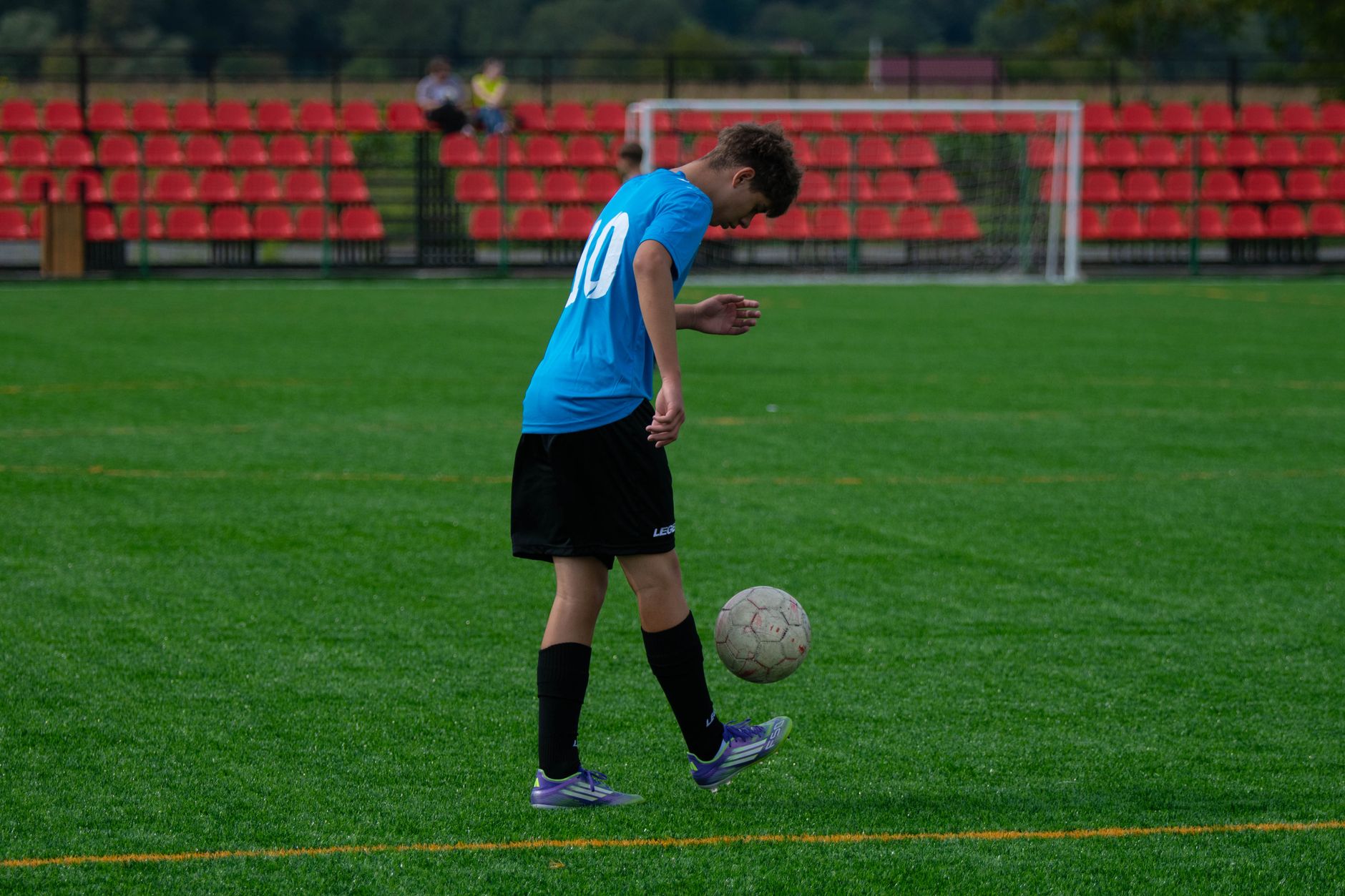
Photo by Angelo Festi on Pexels
Myth 1: More training always produces faster improvement — debunked
Many players believe that football ability is simply a reward for suffering longer than everyone else. That idea sounds noble until your first groin strain, irritated Achilles tendon, or month-long loss of confidence. More training can improve performance only when the workload is recoverable, technically purposeful, and progressively structured. Five poor sessions do not automatically beat three excellent ones.
The better question is not, “How many hours did I train?” It is, “What adaptation was this session designed to create?” A technical session may target receiving with the back foot, while a conditioning session may target repeated sprint ability. Combining both at full intensity every day usually reduces execution quality. Once fatigue changes your body position, scanning frequency, and passing accuracy, you may be rehearsing mistakes rather than skills.
A useful workload rule is to increase total training time or high-intensity volume gradually, commonly by about 5–10 percent when your body is tolerating the current level. That is not a universal medical prescription, but it is a sensible guardrail for recreational players. Record session duration, intensity from 1–10, soreness, sleep, and any pain. If your sprint speed drops sharply or your touch becomes unusually heavy, stop adding volume. This approach is less glamorous than training until collapse, but it is how you remain available for matches.
Want a clearer football-learning framework before building your week?
Myth 2: Ball mastery is enough for match performance — partially true
Ball mastery is essential, but isolated control does not automatically transfer to an 11-a-side match. A player can complete 200 stationary sole rolls and still lose possession because they failed to scan, misread pressure, or choose the wrong pass. Technical repetition builds movement reliability; realistic pressure teaches when and why to use that movement.
The strongest progression moves from predictable to unpredictable conditions:
- Unopposed technique: Pass, receive, dribble, and turn with correct body mechanics.
- Passive pressure: Add a defender who restricts time and space without tackling aggressively.
- Active pressure: Require decisions against a live opponent.
- Game transfer: Use the skill in a 2v2, 3v3, 4v4, or directional game with scoring rules.
For example, practice a receive-and-turn drill with a partner. The receiver checks both shoulders before the ball arrives, opens the hips, takes the first touch away from pressure, and passes through a marked gate. Progress by allowing the defender to intercept. Count successful actions under pressure rather than counting every touch. This gives you a more useful metric: perhaps 18 of 25 controlled receptions, not “500 touches completed.”
To understand how elite teams convert technical skill into decisions, explore our [Internal Link: football tactics and formations guide]. The same principle appears in FIFA World Cup analysis: technique matters, but context decides whether technique survives.

Photo by Pablo on Pexels
Myth 3: You need professional equipment and a full gym — flat-out false
You do not need a GPS vest, resistance sled, private coach, or Premier League training ground to begin training for football. Equipment can improve measurement and variety, but the foundations are acceleration, deceleration, coordination, passing, receiving, mobility, and repeated decision-making. A ball, four objects for markers, a safe surface, and a training partner are enough for a surprisingly strong starting plan.
That said, equipment can reduce certain risks when used correctly. Proper football boots should match the playing surface; firm-ground boots are not designed for artificial turf in every condition. A resistance band can train hip stability, but it cannot replace football movement. A stopwatch can measure sprint intervals, although timing errors from hand-starting often make small improvements meaningless. If you measure sprint progress, use the same distance, surface, start position, and timing method each time.
A minimum home or park setup could include:
- One properly inflated football.
- Four cones or visible markers.
- A stopwatch or phone timer.
- A resistance band or backpack for light loading.
- Water, weather-appropriate clothing, and a first-aid plan.
- A written training log.
The American College of Sports Medicine supports progressive resistance training and individualized exercise planning, while FIFA 11+ provides a recognized football injury-prevention warm-up model. Neither source says expensive equipment is a prerequisite. They point toward consistency, preparation, and appropriate progression.
What actually works: a football training plan built around transfer
What actually works is a weekly plan that connects technical skill, physical qualities, and match decisions without burying you in fatigue. A beginner should generally start with three structured sessions plus a match or small-sided game, while an experienced player may tolerate four to six sessions if intensity is distributed carefully. The exact schedule depends on age, injury history, work, school, sleep, and current fitness.
What should a beginner football training week include?
A beginner football training week should include two technical sessions, one game-based session, one strength session, and at least one full recovery day. Each training day needs a clear objective, a progressive warm-up, football-specific work, and a short cooldown rather than an unplanned collection of exhausting drills.
A practical seven-day structure looks like this:
| Day | Main focus | Example workload |
|---|---|---|
| Monday | Technical foundation | 60 minutes: passing, first touch, dribbling |
| Tuesday | Recovery or mobility | 20–30 minutes: walking, mobility, light stretching |
| Wednesday | Speed and strength | 45–60 minutes: acceleration, squats, lunges, calf work |
| Thursday | Technical pressure | 60 minutes: scanning, receiving, 1v1 decisions |
| Friday | Rest | No hard training |
| Saturday | Match or small-sided game | 60–90 minutes, with a controlled warm-up |
| Sunday | Recovery and review | Easy movement plus training-log review |
Why is Wednesday speed and strength rather than another marathon technical session? Because football requires force production and braking. A player who can dribble beautifully but cannot accelerate into space or stop safely remains limited. Include 6–10 short sprints of 10–20 metres with full recovery, then use two or three sets of controlled strength exercises. Quality matters more than exhaustion.
How should you structure one football training session?
A football training session should usually follow five stages: preparation, technical activation, the main skill, game-speed application, and recovery. For a 75-minute session, allocate approximately 10 minutes to warm-up, 15 minutes to basic technique, 25 minutes to the main drill, 15 minutes to opposed play, and 10 minutes to cooldown and notes.
The first stage should raise body temperature gradually through jogging, movement patterns, and ball involvement. Avoid aggressive static stretching before sprinting or explosive work; dynamic actions such as skips, lunges, controlled changes of direction, and progressive runs are more suitable for preparation. Then move quickly into the skill you want to improve. If the session target is passing under pressure, do not spend 30 minutes on unrelated juggling simply because it feels comfortable.
A useful session design is:
- Constraint: Limit time, space, touches, or passing options.
- Decision: Force the player to scan and select an action.
- Feedback: Correct one or two technical details immediately.
- Progression: Increase pressure only when execution remains stable.
- Test: Finish with a measurable game or target challenge.
Record an outcome such as “completed 14 of 20 passes through the gate under active pressure.” That number tells you more than a vague feeling that the session went well.
Get started with practical football drills and tournament-level analysis from Pitch Notes.
Which drills improve football skills fastest?
The fastest improvements usually come from drills that repeat a key action while gradually adding pressure, direction, and decision-making. Passing against a wall, receiving across the body, slalom dribbling, 1v1 changes of direction, finishing from different angles, and small-sided games are effective when each has a measurable purpose.
Try these football drills:
- Wall passing: Complete 50 passes with the right foot and 50 with the left, receiving across your body. Progress by moving farther away or using one-touch passes.
- Four-gate first touch: Place four gates around you, call a color or number, and direct the first touch toward that gate. This trains perception before execution.
- 3v2 transition: Attack quickly after winning the ball, then recover immediately when possession changes. This develops decision speed and defensive reaction.
- Repeated sprint drill: Perform 6–8 sprints of 15 metres, resting 45–75 seconds. Stop if speed or mechanics deteriorate.
- Finishing sequence: Take one-touch and two-touch shots from the edge of the box, alternating feet and angles. Track shots on target, not only goals.
- 4v4 directional game: Use small goals or end zones and reward forward passes. This creates frequent touches, transitions, and scanning opportunities.
After four weeks, compare your first-touch success rate, passes completed under pressure, shots on target, and sprint consistency. Improvement is not always visible in highlight-reel moments. Sometimes it is simply losing the ball two seconds later than before, which is still progress.

Photo by Quyn Phạm on Pexels
How much strength and conditioning does football require?
Football conditioning requires repeated acceleration, deceleration, running, jumping, and recovery between efforts rather than only long-distance jogging. Two weekly strength exposures can be useful for many healthy adults, while one carefully supervised session may suit beginners, adolescents, or players returning from injury. Strength work should support football, not leave your legs unusable for Saturday.
Prioritize movement patterns:
- Squat: Split squats, goblet squats, or bodyweight squats.
- Hinge: Romanian deadlifts or single-leg hip hinges.
- Push and pull: Push-ups, rows, and controlled shoulder work.
- Calf and ankle: Straight-knee and bent-knee calf raises.
- Trunk control: Side planks, dead bugs, and anti-rotation presses.
- Adductors: Copenhagen plank progressions, introduced gradually.
Use two or three sets of 6–12 controlled repetitions for many strength exercises, leaving one to three repetitions in reserve rather than reaching failure every time. For sprint training, complete short efforts with generous recovery. Long, slow runs can improve general aerobic fitness, but they do not fully reproduce the stop-start profile measured in football matches.
The World Health Organization recommends regular physical activity and muscle-strengthening work for adults, but football players still need sport-specific planning. “Some physical activity is better than none,” the World Health Organization states; for football, the practical extension is that a sustainable plan beats an ambitious plan abandoned after ten days.
What to ignore: training advice that sounds impressive but fails in practice
Ignore anyone promising a guaranteed transformation in seven days, a magic dribbling pattern, or a supplement that replaces sleep and food. Also ignore rigid claims that every footballer must train twice daily, run five kilometres every morning, or complete exactly 10,000 touches. Professional players have medical teams, periodized schedules, nutrition support, and recovery resources that recreational players usually do not have.
Be cautious with social-media drills performed at extreme speed without explaining their purpose. Complexity is not the same as difficulty, and difficulty is not the same as transfer. A trick that looks impressive in a vertical video may contribute little if you cannot execute a simple scan, first touch, or pass under pressure. Ask three questions before adopting advice:
- What football action does this exercise improve?
- How will I measure whether it transfers to games?
- What recovery cost and injury risk does it create?
Ignore pain-dismissal culture, too. Ordinary muscular soreness can occur after a new session, but sharp pain, swelling, instability, altered gait, or pain that worsens during activity deserves medical evaluation. [Internal Link: football injury prevention and recovery guide] can help you organize sensible precautions, but it cannot diagnose an injury. A qualified physiotherapist or sports physician should handle persistent symptoms.
Why does recovery matter as much as football training?
Recovery matters because adaptation occurs after training, when the body repairs and consolidates the stress created by exercise. Seven to nine hours of sleep is a useful adult target, while hydration, adequate carbohydrate intake, and sufficient protein support repeated football sessions. Without recovery, technical quality, sprint output, reaction speed, and mood can all decline.
A simple recovery checklist includes:
- Sleep at a consistent time and aim for adequate duration.
- Eat carbohydrate before demanding football sessions.
- Include protein across the day rather than only at dinner.
- Replace fluids lost through sweat, especially in hot conditions.
- Keep one full rest day when workload or soreness is high.
- Use light movement instead of forcing another hard session.
Here is a less obvious operational point: fatigue is often visible first in decision-making, not in dramatic muscle pain. In my own playing years, I could still run while repeatedly choosing the wrong pass and arriving late to challenges. That was not toughness; it was a quality-control failure. If your training log shows two consecutive sessions with unusually poor decisions, heavy legs, and reduced sprint sharpness, reduce intensity before your body makes the decision for you.

Photo by Andrea Piacquadio on Pexels
Measuring progress without fooling yourself
Progress in football should be measured through repeatable indicators that reflect match demands. Goals and assists are useful but noisy; a midfielder may play well without producing either, while a striker can score after a poor overall performance. Combine technical, physical, tactical, and wellness measures to avoid chasing one flattering statistic.
Track four categories:
- Technical: First-touch success, pass completion under pressure, weak-foot actions, shots on target.
- Physical: 10-metre sprint time, repeated sprint consistency, jump quality, session duration.
- Tactical: Scans before receiving, forward actions, recovery runs, positioning errors.
- Wellness: Sleep hours, soreness from 0–10, stress, motivation, and perceived exertion.
Retest every three or four weeks under similar conditions. Do not compare a cold-weather sprint on wet grass with a warm-weather sprint on artificial turf and call the difference improvement. Similarly, video one small-sided game each month and review the five seconds before every possession loss. That review often reveals a failure to scan or poor body orientation, which isolated ball work may never expose.
For readers following elite football, Pitch Notes connects these training principles with FIFA World Cup 2026 team tactics, player statistics, and match predictions. Use professional examples as references, not as instructions to copy professional volume. Follow our [Internal Link: FIFA World Cup 2026 team performance analysis] for tactical context.
Frequently Asked Questions
Q: What is the best way to train for football?
A: The best way to train for football is to combine technical practice, game-based decision-making, speed, strength, and recovery across three to five weekly sessions. Spend at least two sessions on passing, receiving, dribbling, and finishing, then add small-sided games to create pressure and realistic choices. Include short sprints and progressive strength work rather than relying only on distance running. Track measurable outcomes such as first-touch success, passes under pressure, and shots on target for four-week comparisons.
Q: How can a beginner start football training?
A: A beginner can start football training with three 45–60-minute sessions per week and one optional recreational game. Begin each session with a dynamic warm-up, practice one technical theme, add a simple pressure drill, and finish before technique deteriorates. Use a ball, four markers, a safe surface, and a notebook; expensive equipment is unnecessary. Rest at least one day after demanding sprint work, and increase total workload gradually.
Q: What is the difference between football drills and small-sided games?
A: Football drills isolate or emphasize a specific action, while small-sided games combine technique, perception, decisions, and movement under pressure. A wall-passing drill may improve receiving mechanics, but a 4v4 game tests whether you can scan and execute when opponents close space. Use drills to build reliability and games to test transfer. A balanced session should include both, progressing from predictable practice to realistic competition.
Q: Why is football training not improving my match performance?
A: Football training may not improve match performance when it lacks pressure, decision-making, progressive overload, or position-specific context. Completing stationary touches does not guarantee better play if you never receive while scanning, turning, or protecting the ball from an opponent. Record match errors and identify whether they involve technique, perception, positioning, or fitness. Then redesign two weekly exercises around the most frequent problem instead of repeating comfortable drills.
Q: How much does it cost to train for football?
A: Basic football training can cost very little if you already have access to a ball, public pitch, and suitable footwear. A practical beginner setup may require only a football, four markers, water, and a notebook, while club fees, coaching, facility hire, and gym access add regional costs. FIFA 11+ materials are widely available through football organizations, although supervised coaching remains valuable. Spend first on safe footwear and reliable instruction before buying gadgets.
Q: How many times a week should I train for football?
A: Most beginners should train three times weekly, with one optional match or small-sided game and at least one complete rest day. Experienced players may handle four to six sessions if hard running, sprinting, strength work, and matches are distributed rather than stacked together. Avoid placing maximal sprints immediately before a competitive match. If sleep, mood, touch, and sprint quality decline for several days, reduce volume and recover.
Q: What should I do if football training causes pain?
A: Stop the painful movement and seek qualified medical advice if pain is sharp, worsening, associated with swelling or instability, or changing how you walk or run. Mild delayed muscle soreness can be monitored, but it should not be used to justify playing through joint or tendon pain. Record when the pain started, which action triggers it, and whether it changes after rest. A sports physiotherapist can assess the problem and provide a return-to-play progression.
Football training does not need to be brutal to be effective; it needs to be specific, measurable, progressive, and repeatable. Build your week around quality touches, pressure-based decisions, short high-quality sprints, basic strength, and enough recovery to perform again. Review your numbers every four weeks, adjust one variable at a time, and treat persistent pain as information rather than weakness. That is the boring answer I wish I had followed earlier, because it keeps you improving instead of repeatedly starting over.
Want to apply these principles to your football development and follow deeper FIFA World Cup analysis?
[Internal Link: personalized football training plan and progress tracker]
End of transmission.
Pitch Notes • Neon Protocol • System Active